 09 December 2025
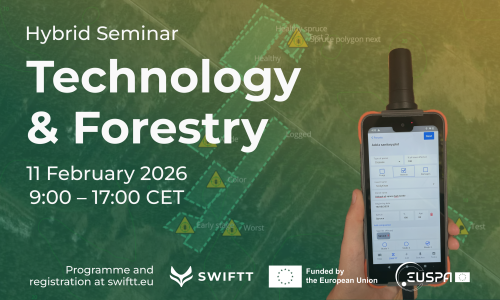
The SWIFTT project invites foresters, forest managers, and other forestry experts to its upcoming hybrid seminar, “Technology & Forestry,” taking place on 11 February 2026, from 9:00 to 17:00 CET, at Terblock Castle, in Overijse, Belgium, 25km from Brussels.
The event will feature a live demonstration of the SWIFTT platform and presentations from project team, allowing participants to discover how it supports timely, data-driven decision-making in the field, and helps foresters detect and prevent spruce bark beetle outbreaks, as well as analyse windthrow and fire damage.
Various forest stakeholders from the public and private sectors will also talk about their solutions for a sustainable forest management across Europe.
Register to secure your spot in either the in-person or the online event: https://forms.gle/69yc87j3nHLB5LJf7
Check out the programme in the link below.
About SWIFTT
Insect outbreaks, wildfires, and windthrow are responsible for most of the biomass loss in European forests. These threats are intensified by climate change: the ever more frequent extreme weather events – like droughts, heatwaves, and storms – make trees even more vulnerable to insects and pathogens, damage and uprooting by strong winds, and to becoming dry fuel for wildfires which spread faster and burn for longer.
By combining the rich Copernicus Sentinel satellite data and powerful machine learning models, SWIFTT will help foresters (i) identify changes in tree health, map dieback in their forests caused by spruce bark beetles and coordinate sanitary cuts faster, (ii) map windthrow damage after a storm for post-storm forest management, and (iii) analyse fire damage & identify areas at high risk of wildfires. The solution will increase forest management productivity and cost-effectiveness, and enable forest managers, authorities, and policymakers to deal with forest threats proactively.
SWIFTT is funded by the European Union under Grant Agreement 101082732. Views and opinions expressed are, however, those of the author(s) only and do not necessarily reflect those of the European Union or European Union Agency for the Space Programme (EUSPA). Neither the European Union nor the granting authority can be held responsible for them.
 More Information